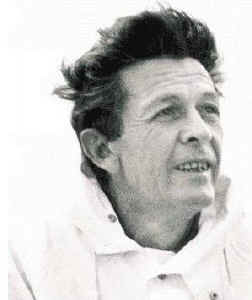
In the end,
while the large majority of the P.C.I. electors (let alone of the Italians) understood and
approved his shift, within his party Occhetto was overtaken - at least nominally - both
from the left (the dissidents of Rifondazione Comunista) and from the right (the
new DS leaders). Shamefully, he was also marginalised, ignored, and to some extent banned
by the new leaders of the DS, i.e. by the very same party he founded.
Still up and
running
Occhetto was deeply saddened
by his unjust alienation. Nevertheless, after a few years of reflection, also spent
writing a book (Secondo me, "According to me", an interesting insight
into the history of the P.C.I.), he steamed ahead. As he deemed his former party too
moderate in the attempt to please electors of the centre
to
defy PM Berlusconi, he formed an
off-the-beaten track alliance and founded a party with Antonio Di Pietro. The former judge
of the trials on political bribery in the 90s, Di Pietro is now a politician
radically supporting uprightness in the Italian political world, while also embodying traditional, popular cultural
traits. The party (called Italia dei Valori, "Italy of Values")
defended uprightness in the government and in the public authority - another teaching of
Enrico Berlinguer - and also tackled the conflict of interest regarding PM Berlusconi, the
business magnate monopolizing Italian politics and the Italian economy.
In the June 2004 European polls the result was not good. The reason lies in the different
political orientation of the party leaders and of their electors, as Di Pietro's are far
more moderate than Occhetto's. The latter announced that he and his group will separate
from the party. Yet Occhetto
didn't throw in the towel: he
just founded the "Cantiere per il Bene Comune" or
"Building yard for the Common Good", a society whose plan is to help
founding the above mentioned "true left".
The Italian centre-left, currently
The Italian left is traditionally diversified.
Not only parties, but also denominations, coalitions, nicknames, synonyms and definitions
abound. There follows a synoptic table (coloured cells explain political standpoints or
coalitions). Also shown is the percentage of votes in the 2004 European polls.
Centre-left
coalition: 44.2% (the centre-right coalition has equal strength). |
"Ulivo" (Olive tree, official name) coalition: 35.7% |
Olive tree
allies: 8.5% |
Moderates |
Radicals |
Uniti
nell'Ulivo ("United within the Olive Tree" aka "Tricycle"):
31.1% |
United in the
2004 European elections (Italia dei Valori), now separated: 2.1% |
|
- Democratici di Sinistra
(DS)
- Margherita ("Daisy") including Partito
Popolare Italiano P.P.I. (Ital. Popular Party, Catholic) and liberal-democrats.
- Socialisti Democratici Italiani S.D.I. (Social Democrats). |
Lista di Pietro |
Occhetto's group |
Federazione dei Verdi:
2.5% (Green Party) |
Partito dei Comunisti Italiani-P.d.C.I.:
2.4% (Party of the Italian Communists, originated in 1998 from Rifondazione
Comunista, and less radical). |
Rifondazione Comunista
6.1% |
Notably, all post-WW2 left-wing parties disappeared, and all the current ones are very
recent. The Green Party, usually the most recent party in the West, and founded in Italy
in 1986, is the oldest of the present ones (!). The same phenomenon occurred
to
centre-right parties. This testifies to the outstanding dynamism and creativity of Italian
politics, yet it also demonstrates that hardly political forces are able to
continue from
generation to generation. The probable reason is that the evolution of the complex - and
complicated - Italian society is faster than the source of ideas and solutions provided by
the parties. This explanation might seem a valid justification; however it prompts a few
considerations.
|
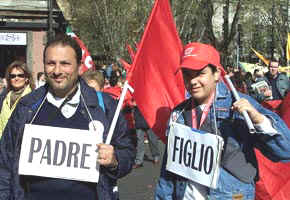
Like father like son? A questionable
continuity |
Distinctive features of the Italian political movements
(a)
The middle class
It is no surprise that Italy undergoes major
changes in the present swiftly changing world. Yet changes occurring in Italy are more
profound than in other western countries because the "Bel Paese"
(Nice Country, one of the nicknames the Italians give to their homeland) has
a wider gap to fill. Namely, the industrial revolution which changed Europe
in the last two centuries was only partially effective in Italy. Reference
is not only to the renowned North-South gap, but also to the incomplete
creation of an established "Civil
Society", following the ideals and the social and
economic patterns brought by the European Enlightenment. In other western
European countries, it was the middle class who took upon itself the burden
of the process. In the 19th century, the Italian middle class fulfilled entirely
and also heroically the responsibility, during the process called Risorgimento (Resurgence),
which brought to the reunion and independence of the country. The Italian
patriots were admired internationally not only for their bravery, but also for their
political creativity, and frequently also for their great
erudition. They mostly belonged to
the upper-middle class.
However, the newly born Italian Kingdom
which they founded (1861 AD) was unable to fulfill the ideals of
the Resurgence. It was a class-based, conservative and increasingly nationalistic society.
Notably, many Italians found the society under Fascism
closer to the people than the
pre-WW1 elitarian Monarchic society. This was one of the reasons of the popularity of
Fascism. To many Italians, the Fascist regime delivered more public
infrastructures and more working opportunities (especially in the Civil Administration, or
in the Army), and it was perceived as being less distant
than the Monarchic regime. Also the middle class in
general appeased Fascism, despite its wrongdoings.
On the other hand, as opposed to other western countries, many individuals of the middle
class contributed to the achievement of the left-wing or Catholic political
forces. For example, both the above mentioned Berlinguer and Occhetto belonged to the
middle class. So while the middle class failed to become the backbone of a modern country,
many individuals, with an idealistic and quasi-missionary approach, were essential
to carry on the ideals of political forces frequently at odds with the interests and
outlook of the very class they belonged to.
(b) The working class
| The above mentioned
incomplete emancipation of Italy (together with its overpopulation) brought
about the migration
of millions of Italians in the second part of the 19th century and in the early years of
the 20th century. At the turn of the 20th century, as it occurred in all other European
countries, workers founded political parties to protect themselves from exploitation and
defend their rights.
Later, such parties had to defend themselves from
Fascist tyranny, which they fought back during WW2. After the collapse of the country
following WW2, the workers' political organizations - especially the parties and the trade
unions - contributed to the foundation of the newly born Italian Republic. At this stage,
when the gap accumulated by Italy compared to other western countries was
greater, the
workers and their organizations were called to an effort not only of reconstruction of the
devastation brought by the war, but also of construction of key aspects of the country. |
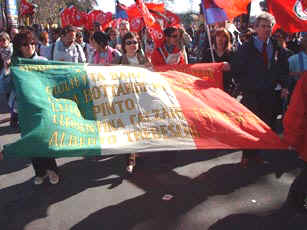
Women rallying |
As result of the inadequacy of the middle
class to construct a complete country, symmetrically and distinctively the workers' political organizations
thus
filled the gap, acquiring managerial and governmental responsibilities.
One of its consequences was that a strong welfare state
was established and maintained. The Socialist Party
(P.S.I.) ruled Italy for nearly 30 years from 1963, together with the prevailingly
conservative Christian Democrat Party (D.C.). They mediated and reached a compromise with
the P.C.I. on important issues throughout the duration of their various governments. The P.C.I. was also the most elected party in five "red" regions, usually of
central-northern Italy, thus administering advanced economy areas.
As a result of all the above mentioned factors, unlike other western
countries, in Italy the working
class in the last century didn't consider the middle class a political reference. The general idea
was that the middle class didn't have political, social or cultural commitment, and that it
was primarily concerned with its own interests. The moderate left also always believed
that the free trade policy in economy - deeply
rooted in
the middle class - needed
corrections to avoid individualism and to reallocate wealth also to the weaker classes.
Moreover, the extreme left rejected the free trade policy as selfish and aggressive (Bertinotti, the
leader of Rifondazione Comunista states "The freedom they talk about is
their freedom, achieved at the expense of someone else, the
workers"). Conversely, the general belief was that the workers' organizations
were more cultured, farsighted and capable of addressing any
political, social or economic issue for
the wellbeing of all. Whether this was right or not,
for 40 years the Italian
left-wing endured a cultural hegemony in Italy. A left-wing outlook on
most things was not
only trendy, but practically mainstream. The most alluring reviews and papers, the most
attractive TV shows, the most read books, were all left-wing.
The middle class comeback
In 1993 the so called centre-left government
came to an end ruinously. The magistrates found that many politicians, mostly of the D.C.
(Christian Democratic Party) and of the P.S.I. (Socialist Party), allied and ruling Italy,
had been bribed. The culprits claimed that bribery was meant to lobby their parties, and
that it was a customary, ordinary business in Italy. The massive bribery - dubbed Tangentopoli
"Bribe town", or Mani Pulite "Clean Hands" - arouse general
indignation. To most Italians it was the last straw, as they had enough of the ruling
establishment, which appeared corrupt and inefficient.
When in 1963 the P.S.I. broke up the strict alliance with the P.C.I. to join the
apparently centre D.C. to form the "centre-left" government, one of its purposes
was to lead the D.C. along a centre-left, liberal path. As a matter of fact, quite the
opposite occurred. The liberal character of the P.S.I. vanished over the
years. It became a centre party, mainly concerned with holding power, and having as many
key-positions (and in turn power) for its members. The D.C. purported it was an
ecumenical,
universal party, representing all social classes and orientations, with a left, a centre,
and a right-wing within the party. Actually, its right-wing ruled the party, and thus the
entire country. It held most of Italy's key positions and power, and it thus ultimately
controlled, and in the long run changed the P.S.I., eager to have more and more power.
The two parties, and especially the D.C., set up a gigantic, ruthless, diabolical - and
disgusting - patronage system or clientelismo, promising jobs and
"favours" (= unfair advantages) to their "clients" in exchange of
votes. Under their rule, productivity decreased, the Italian economy lost competitiveness,
and with it the entire country simply collapsed.
In the 1994 elections the left coalition, which had
opposed the centre-left government for more than 30 years was thus favourite, but at that stage something
unexpected happened: the centre-right wing middle class appeared on the scene, and it won
the elections.
After more than half a century of bad government, of inefficient and unfair public
authority, the Italians naturally sought uprightness in the central government and in the
public authority. Yet they wanted their country to be finally modern, without the quirks
and quibbles they face every day. The popular password was to seek "normality".
The Italians also sought an efficient economy delivering prosperity. They were allured by Silvio Berlusconi, a magnate who made his way through building firms, real estate
speculations, and advertising with his privately owned TV stations. Berlusconi wooed
electors promising to reverse the economic downturn by implementing efficiency and
economic free trade ideas in the Italian economy. The favourite slogans bombarding electors was
that he was going to create one million new jobs during his mandate, and that he was going
to reduce taxes. Berlusconi's newly founded party, Forza Italia ("Go Italy") became
the hinge of the centre-right wing coalition which won the elections, thanks also to the
massive hyping up through his privately owned TV stations.
Berlusconi's
rule
Fifty-six
years after WW2 thus political forces openly
representing the middle class, and centre-right, ruled Italy (the D.C. as mentioned
pretended to be a universal party, representing all classes). Yet Berlusconi's coalition,
still ruling Italy, despite the denomination resembling that of similar forces in the west
- "Casa delle liberta'", i.e. House of (all) freedoms -, is far from
being the "normal" i.e. constructive, enlightened middle class force, which
Italy never had since its independence, as opposed to the other advanced western European
countries. Never mind Berlusconi's self-righteousness and frequently insulting
arrogance. Politics is not for the weak of heart, and such personal traits are subjective.
In fact Berlusconi's admirers consider them signs of his leadership, deeming him the
saviour of the fortunes of the country. What though is
unacceptable of
Berlusconi and of his party is the lack of political fairness, and his unscrupulousness.
He tries to own as many media he can (TV stations, papers, reviews etc.), where his
journalists plug him and his ideas gaining public consent, and thus political power, with
which in turn he controls the state-owned TV stations, multiplying public consent and
power. He is always on TV for some reason, whether because interviewed, or even as
president of the Milan AC football club. Seemingly Berlusconi considers Italians
"vidiots" which he can easily influence, as his media strategy is prepared in
a clear-headed way.
Naturally, Berlusconi is also omnipresent in the political arena: he is PM, yet at times
he appointed himself also as Foreign Minister and Minister of Finance. When
magistrates indict him on a number of cases of corruption, he in turn wages war upon them,
discrediting them as puppets in the hands of the left-wing, thus reversing the
allegations, as if they persecuted him rather than prosecuted him. Moreover, to avoid
investigation, or to be acquitted, the coalition that he leads passes specific bills,
sometimes "ad personam" or "a la carte", to favour him or his friends
in particular trials. His conflict of interest is consequently unheard of in western
countries, and he obviously does very little to regulate it.
Economy-wise, Berlusconi and his coalition promised to bring prosperity by implementing
free market, reducing taxes, thus stimulating a thriving economy, and creating millions
new jobs. Actually, taxes were not reduced, and there are talks of an upcoming tax squeeze
to save the national revenue. There was no significant amelioration of the status of
large companies or corporations. The welfare service was dramatically reduced, while
in general the government stimulated a private, individual approach to work. The "one
million jobs" were not created, and Berlusconi's companies (Mediaset, RTI etc.)
shamefully did not even employ the compulsory quota of disabled or refugees. Finally,
important workers' rights were contested and debarred.
The major outcome is that professionals and merchants (especially of low profile)
increased their expectations, and they have become greedy - despite they deliver a bad
service. Moreover, scores of self-styled "entrepreneurs" - mere speculators,
usually petty and operating borderline illegally - feel encouraged. As a result inflation
skyrocketed and prices nearly doubled in three years (!).
Workers,
employees, the retired, and the unemployed cannot change their income, and they are on the
edge of poverty.
In conclusion, Berlusconi's purported "new Italian miracle" is only delivering
social problems and conflicts, and an unfair society. The "miracle" is also
generating an even worse consequence: it is subtly changing negatively the Italian
culture. The Italians were renowned as gracious, tactful, and compassionate people. If you
visit Italy you will find out that they have become increasingly litigious and concerned mainly
about their own businesses.
The 2006 left revenge
With a very close victory, in 2006 the
centre-left dethroned Berlusconi's centre-right coalition. Yet it is
doubtful that the new rulers, led by Romano Prodi (a former
Christian Democrat), will be better than the previous ones. While
Berlusconi is right-wing, overbearing, at times arrogant, and he
frequently favoured his interests (and those of his lobby), at the end of the day
for some aspects he is more liberal than the left-wing
coalition which won the elections. In fact, Berlusconi, at least
nominally, supports a free
market society, and gradually this made a part of the
Italians, traditionally sticking to the idea of a life-long state
job, intrigued by the idea to work hard on their own.
In Italy, the centre-left parties govern well at
the local level (where right-wing politicians usually look
after their businesses - frequently illegal). But when it comes
to central government, the centre-left supports a gigantic state-run
economy, unproductive and inefficient, which enforces to the Italians a stifling bureaucracy.
Also pushed by the Communists, the centre-left mindset brings them to find the revenues from the
income of their all-time favourite
targets, IE professionals, entrepreneurs, dealers, shopkeepers, and in general the productive middle-class. Taxation reaches 40%, plus various
minor taxes totaling or exceeding 50% of earnings (!). In addition, the economy (and practically everything else)
is
bogged down by a mind-boggling and excruciating bureaucracy.
In the end, the centre-left coalition brings two results, which start a vicious
circle: (1) the economy
goes bad because the productive part of the society not only has no
incentives, but it is also ill-disposed against the entire system (2)
the middle class and the professionals will then vote and support the
centre-right coalition. The result is that Italy will have soon
another bold and arrogant centre-right wing government, paving the way to the next comeback of the
centre-left winning the subsequent elections etc. - so the entire
vicious cycle repeats itself - generating a pointless and shortsighted
process, to say the least.
In the end, the missing link
of the Italian left - and of the European left - is its incapability
to understand that the productive elements of society should become its engine,
while they are conceived as opponents (or social enemies -
according to radical leftists). In other
words, within the market
economy (so called "capitalist") the most productive working
categories or social classes should become convinced
partners of liberal ideas and projects, which would also
avoid leaving the core of
entrepreneurial classes in the hands of the centre-right parties,
and of their plans.
It is not only a tactical necessity. In fact, a just and developed society can only be achieved with the
fulfillment
of the hopes of both the individuals and of the community. It is
therefore necessary safeguarding both the longing to elevate oneself of
each individual, and the needs of the community. Actually, the best
solution to reach this goal is to transform the productive classes
into the flywheel of the amelioration of the society, not by simply
collecting as much as possible their resources by taxing them, but by making them
become
convinced partners and pioneers of such far-reaching project.
In conclusion, finding a way
to make the middle class become truly liberal and generous is the
solution the left should seek, rather than sticking to the old clich�s
and to obsolete views, only leading to social fragmentation and to a
sterile social conflict, from which astute and
aggressive conservatory forces find grounds to emerge.
Homepage
www.parcodibovillae.org
BACK TO TOP
The author: Mauro Abate
Born from a mixed, international family and bred in post-WW2 multiethnic Libya, after his
exile he lived in all parts of Italy (North, Centre and South) experiencing
different social ranks and conditions (refugee, unemployed, employee in privately owned
companies, state employee, self-employed). A versatile person, he
practiced successfully
different professions (including that of medical doctor), and he is now an entrepreneur in
the hospitality-tourism business. A free spirit with an international outlook, his main
interests are probably international relations and ethnic conflicts (he dealt extensively
with the Israeli-Palestinian). In this article he takes stock of the Italian
left,
but above all he reflects on the evolutionary dynamics of liberal movements.
Staff |
|
|